
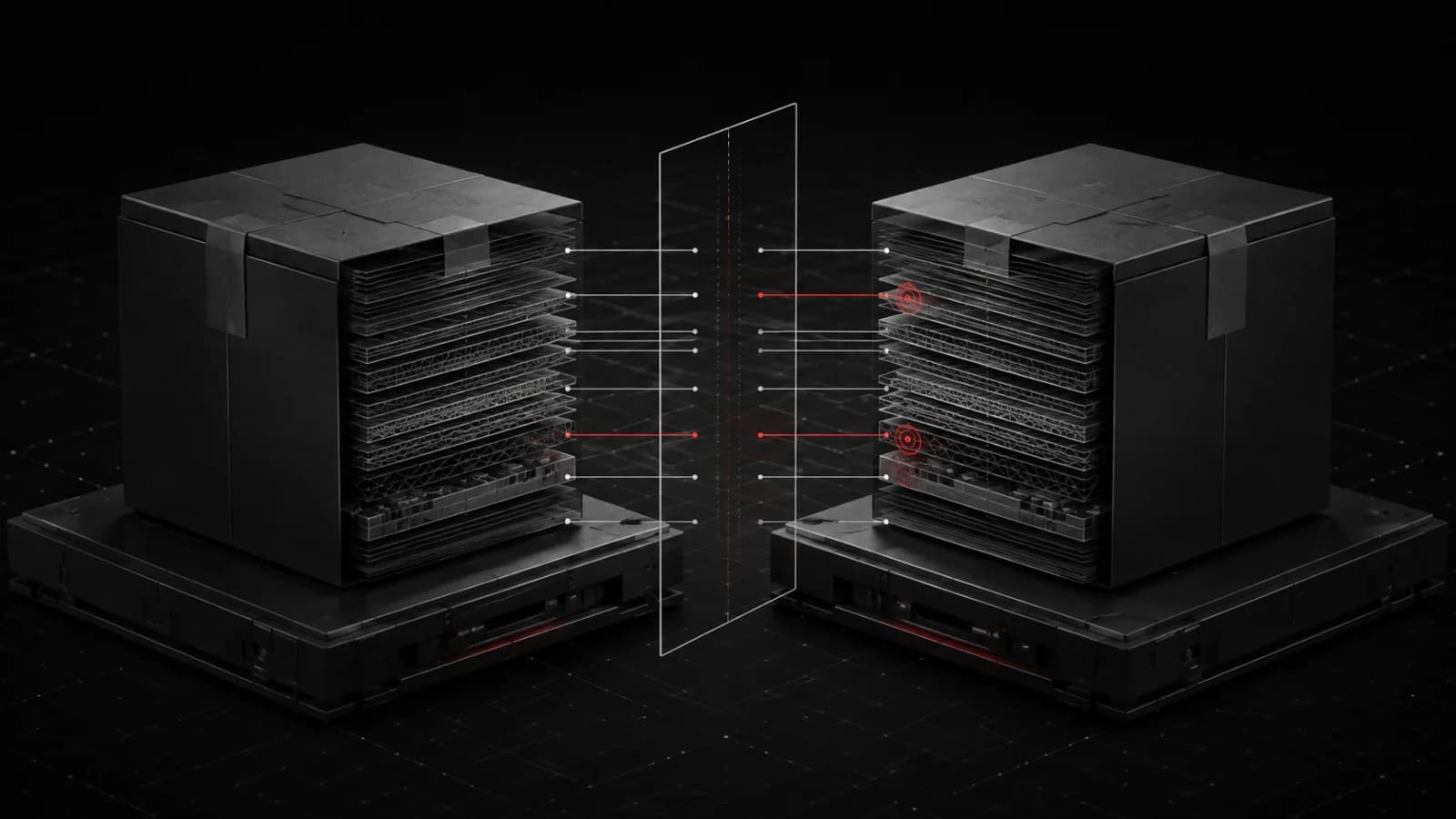
“Built from source” sounds definitive. In practice, it contains several separate assertions: the source revision was identified correctly, the build ran in a controlled environment, the relevant outputs were captured, and the comparison method ignored only differences that are genuinely non-semantic.
When those assertions hold, reproduction provides unusually strong supply-chain evidence. It still does not prove that the package is secure.
Understanding that boundary makes reproducible builds more useful, not less.
First Prove Which Source to Build
The weakest link is often source identity. A repository homepage is not an immutable input, and a version tag is not automatically the commit used for the published package.
Strong evidence starts with an exact commit recorded in package metadata. When that is absent, Source Link mappings, assembly informational versions, and exact release tags can narrow the candidate. Each fallback should be labeled because each supports a different level of confidence.
The rule is simple: never turn a heuristic into a fact by removing its label.
Reproduction Requires a Controlled Build
Running the maintainer's instructions on an ordinary workstation establishes very little. The machine may contain credentials, global tools, cached artifacts, and environment state that affect the result. The repository may also contain scripts that are unsafe to execute without isolation.
A defensible build records and constrains:
- the immutable source revision;
- the build environment and toolchain;
- network and secret access;
- the commands executed;
- dependency inputs;
- output files and digests;
- logs needed to explain failure.
Isolation serves two purposes. It protects the builder from untrusted source, and it makes the evidence easier to review later.
Byte-for-Byte Is Strong but Not Always Available
Some packages reproduce exactly. Others contain timestamps, archive ordering, generated identifiers, paths, or signing material that vary even when the compiled behavior is unchanged.
A normalized comparison can remove known volatile package metadata and then compare meaningful contents: assemblies, portable PDBs, Source Link mappings, dependency declarations, and other shipped files.
Normalization must be narrow and disclosed. If a comparison removes every field that differs, it can always manufacture a match. The excluded data and the remaining differences belong in the evidence record.
A Difference Is Evidence, Not a Verdict
When rebuilt output differs, several explanations are possible:
- the wrong source revision was selected;
- the build depends on an undocumented input;
- the toolchain is not pinned;
- the published package used a private patch or additional file;
- the artifact was modified after the claimed build.
The difference justifies a lower provenance level and further review. It does not, by itself, prove malicious behavior.
This is why “pinned source, output differs” is a useful state. It preserves what was established—the exact commit and isolated build—without claiming reproduction.
What a Match Does Prove
A well-controlled match supports the conclusion that the inspected source and build process can produce the meaningful contents of the upstream package. It gives reviewers a defensible bridge from distributed artifact back to readable source.
That evidence helps answer questions such as:
- Is the assembly consistent with the claimed repository revision?
- Can the package be regenerated without relying on the publisher's workstation?
- Did an unexplained binary or source mapping appear in the distributed artifact?
Those are valuable conclusions during package admission and incident response.
What It Does Not Prove
A reproducible package can still contain:
- a vulnerability present in source;
- deliberately malicious source;
- an unacceptable license;
- unsafe transitive dependencies;
- insecure default configuration;
- a compromised dependency fetched during the build.
Provenance answers where an artifact came from and how strongly the result connects to source. Vulnerability, license, and behavior analysis answer different questions. Publication policy should combine them rather than using reproduction as a universal pass.
Preserve the Full Result
The durable output of reproduction is not a badge. It is a bundle of evidence: source coordinates, build inputs, logs, artifact digests, normalized comparison results, differences, and signatures over the verification record.
Rorix keeps reproduction as one input to a fail-closed publication decision. Read the Trusted NuGet Registry guide for the source-resolution order and provenance levels.
Reproducibility is powerful precisely because its claim can be stated narrowly: this source, under these conditions, produced this result. Security programs become stronger when they resist turning that precise statement into something broader than the evidence supports.